
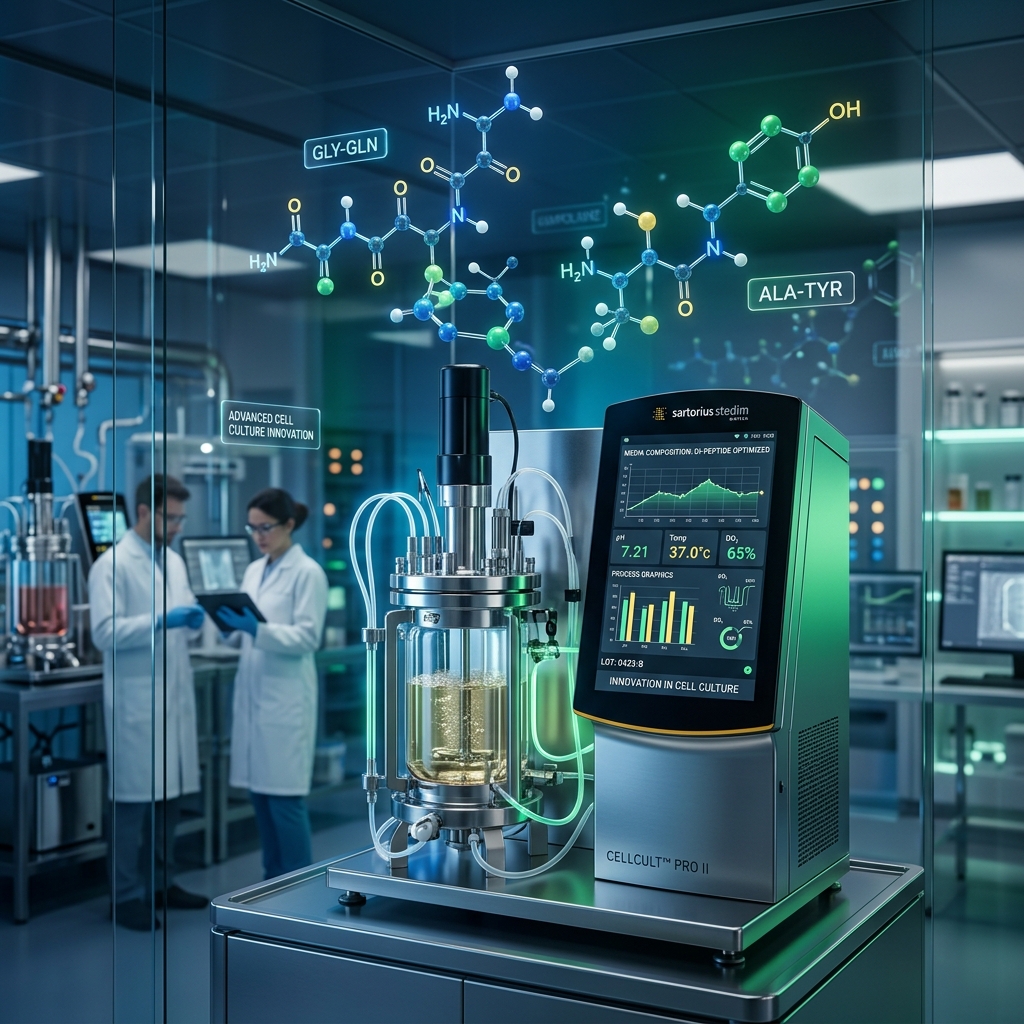
Breaking Through Biomanufacturing Bottlenecks: Core Advantages and Applications of Dipeptide Amino Acids in Modern Cell Culture Media
In the modern biopharmaceutical industry, the formulation of mammalian cell (e.g., CHO cell) culture media has undergone a paradigm shift. To improve safety and consistency, the industry has transitioned from complex, unknown components like Fetal Bovine Serum (FBS) and protein hydrolysates to Chemically Defined (CD) and Animal-Derived Component-Free (ADCF) media.
However, this transition has also exposed the inherent physical and chemical limitations of monomeric free amino acids, which have become major bottlenecks for process intensification. To overcome these limitations, the strategic application of dipeptide raw materials (such as Alanyl-L-Glutamine, Bis-L-Alanyl-L-Cystine, Glycyl-L-Tyrosine, etc.) has become a core technology for significantly improving cell culture process performance and optimizing cell metabolism.
1. Inherent Pain Points of Monomeric Amino Acids in Cell Culture
In traditional high-density Fed-batch and Perfusion processes, the development of media and concentrated feeds is often hindered by several key amino acids:
Solubility and Preparation Challenges (L-Tyrosine and L-Cystine)
- L-Tyrosine: Essential for recombinant protein synthesis, but has extremely low solubility in water at neutral pH and room temperature (approx. 0.45 to 0.48 g/L). Traditional methods require dissolving it separately at extreme pH (>10.0 or <2.0), which increases complexity and risks pH fluctuations, high osmolality, and precipitation in tubing.
- L-Cystine: L-Cysteine is easily oxidized to L-Cystine in aerobic environments, which has a solubility of only about 0.11 g/L at neutral pH, leading to precipitation and reduced bioavailability.
Chemical Instability and Cytotoxicity (L-Glutamine)
L-Glutamine is highly unstable in aqueous solutions and at 37°C. It spontaneously degrades non-enzymatically into ammonia, which is toxic to cells, inhibiting growth and negatively affecting protein glycosylation.
2. Core Technical Advantages of Dipeptide Amino Acids
By chemically coupling "problematic" amino acids with "carrier" amino acids (usually L-Alanine or Glycine), dipeptide technology overcomes these defects:
Exponential Leap in Solubility
Dipeptides achieve a massive increase in solubility:
- Glycyl-L-Tyrosine (GY) and Alanyl-L-Tyrosine (AY) are 50 to 77 times more soluble than free L-Tyrosine at neutral pH.
- Bis-L-Alanyl-L-Cystine (AC) is 30 times more soluble than L-Cystine.
- The next-generation Bis-L-Lysyl-L-Cystine (KC) is nearly 1000 times more soluble than its free state.
This allows for the integration of all nutrients into a single neutral pH feed, eliminating complex feeding systems and reducing contamination risks.
Superior Chemical Stability
Glutamine-containing dipeptides (e.g., Alanyl-L-Glutamine (AQ)) are chemically stable. Since the glutamine structure is locked in a peptide bond, it no longer degrades spontaneously, preventing ammonia accumulation.
Intracellular "Slow-Release" Mechanism
Dipeptide uptake relies on specific transporters (PepT1/PepT2). Once inside the cell, they are cleaved by intracellular peptidases. This acts as a natural slow-release system, avoiding metabolic imbalances like "glycolytic overflow" and redirecting energy toward protein synthesis.
3. Applications in Biomanufacturing
- Enabling High-Density Perfusion: Dipeptides like KC and Glycyl-L-Tyrosine (GY) allow for highly concentrated neutral feeds, supporting ultra-high densities exceeding 100 million cells/mL.
- Boosting Titer and Productivity (Qp): Using Alanyl-L-Glutamine (AQ) can increase antibody titers by up to 94%.
- Ensuring Critical Quality Attributes (CQAs): Dipeptides ensure a steady supply of tyrosine, preventing "sequence variants" and ensuring stable glycosylation patterns.
For modern cell culture media development, transitioning to dipeptide additives is no longer just an "optimization" but a necessity for high-titer, high-stability biomanufacturing.
Explore our high-purity dipeptide products: